




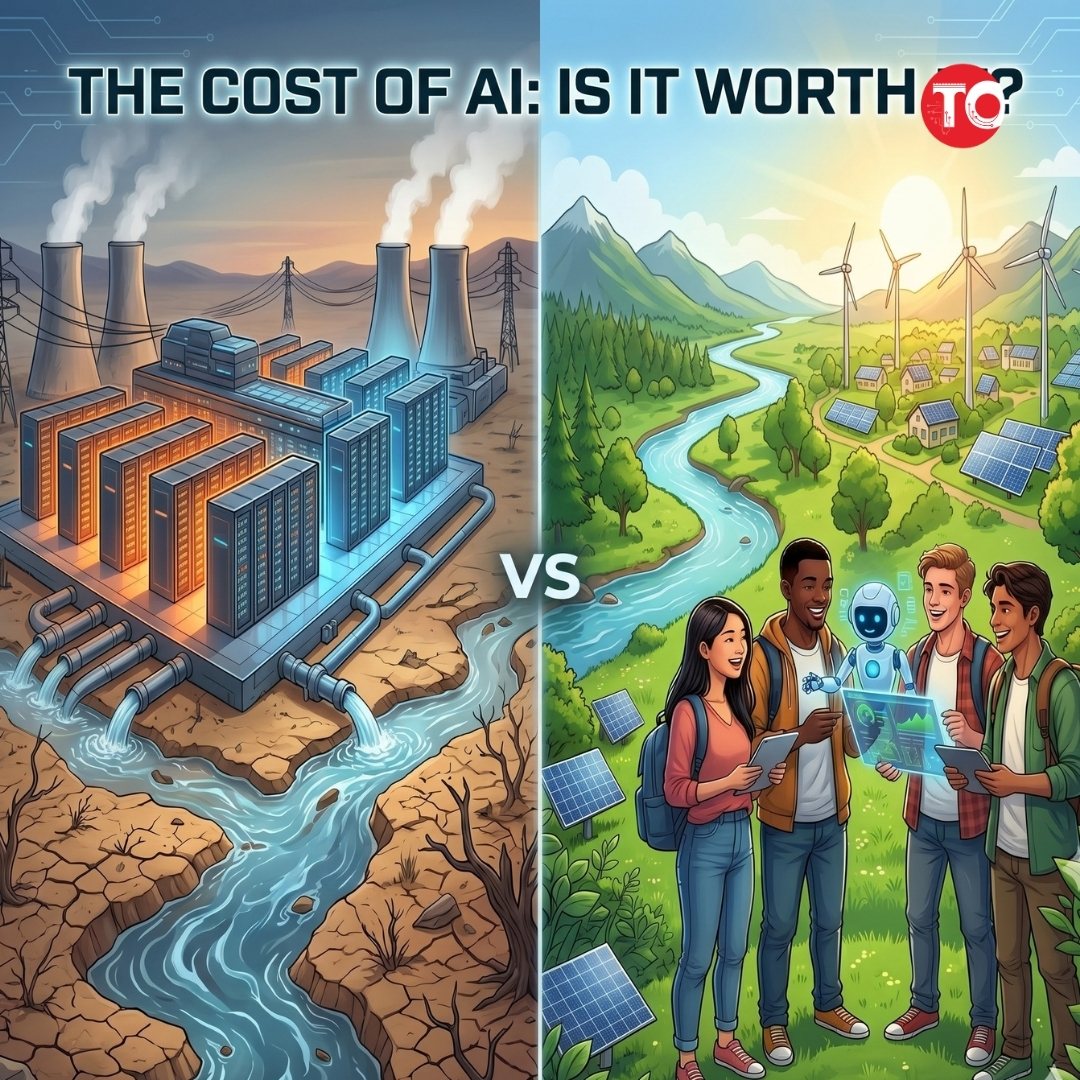
Imagine you’re in your hostel, late at night, asking Co-Pilot to summarize a massive research paper or generate a hyper-realistic image for your design project. On your screen, it looks like magic—silent, clean and instant. But thousands of miles away, a building the size of a football stadium is "sweating" to give you that answer. These are AI data centres and while they feel like "the cloud," they are actually made of heavy metal, rare minerals and millions of gallons of water.
As a generation that cares deeply about the climate, we are facing a new paradox: the very tool that could help us save the planet is also one of its hungriest new consumers. Is the convenience of "Instant Intelligence" worth the physical toll on our natural resources?
The Hidden Appetite of the "Brain"
We often forget that every digital prompt has a physical footprint. AI doesn't just run on code; it runs on heat and electricity.
- The Thirst for Cooling: AI chips get incredibly hot—much hotter than standard servers. To keep them from melting, data centres pump in massive amounts of water. Some facilities use over 5 million gallons a day, which is the same as a town of 30,000 people. In dry areas, this puts a direct strain on local water supplies.
- The Energy Hungry Giant: A single query in a generative AI tool can use 10 times the electricity of a standard Google search. By the end of the decade, it’s predicted that data centers could consume up to 10% of the world’s power.
- The Hardware Waste: The GPUs (Graphics Processing Units) that power AI are upgraded almost every year. This creates a cycle of high-tech trash that is extremely difficult to recycle because it contains rare-earth minerals mined under tough environmental conditions.
The Other Side: AI as a Green Hero
It’s not all bad news. The reason we aren't turning off the machines is because AI might be our best shot at fixing the environment. It is currently being used to design more efficient solar panels, optimize power grids to reduce waste and even track illegal deforestation in real-time. The goal isn't to delete AI, but to use it responsibly.
How You Can Be a "Green" AI User
As students and future tech leaders, you don't have to choose between tech and the planet. You can use AI in a way that respects natural resources. Here is how:
- Be a Smart Prompter: Every time you hit "enter," you use energy. Instead of sending five vague prompts, take a minute to write one clear, detailed prompt. "Prompt engineering" isn't just a career skill; it’s a way to save energy by getting the right answer the first time.
- Choose the Right Tool for the Job: You don't always need a massive, "all-knowing" model for a simple task. If you just need a text summary, use a smaller, "lighter" AI model rather than a heavy image-generation model. Text-based tasks are significantly less carbon-intensive than image or video generation.
- Don't Waste the Output: If the AI gives you a good answer, save it! Re-prompting the same question because you lost the tab is a waste of resources.
- Demand Transparency: Support companies and platforms that are "Water-Positive" or run on 100% renewable energy. As a consumer, your voice (and your choice of tools) pushes the industry to be better.
As you head into your careers, you’ll be the ones deciding how we use this power. If we use AI to solve huge problems like cancer or climate change, the "cost" might be worth it. But if we use it just for digital junk, we’re wasting the planet’s precious resources.
The Path Forward
AI is a powerful tool on our planet, but it’s a high-maintenance one. The future isn't just about how "smart" our AI is but how "sustainable" it can be. We have the power to ensure that the "Ghost in the Machine" doesn't haunt our natural world. By using these tools with intention, we can make sure the hum of the data centre is the sound of progress not the sound of a planet running out of breath.