



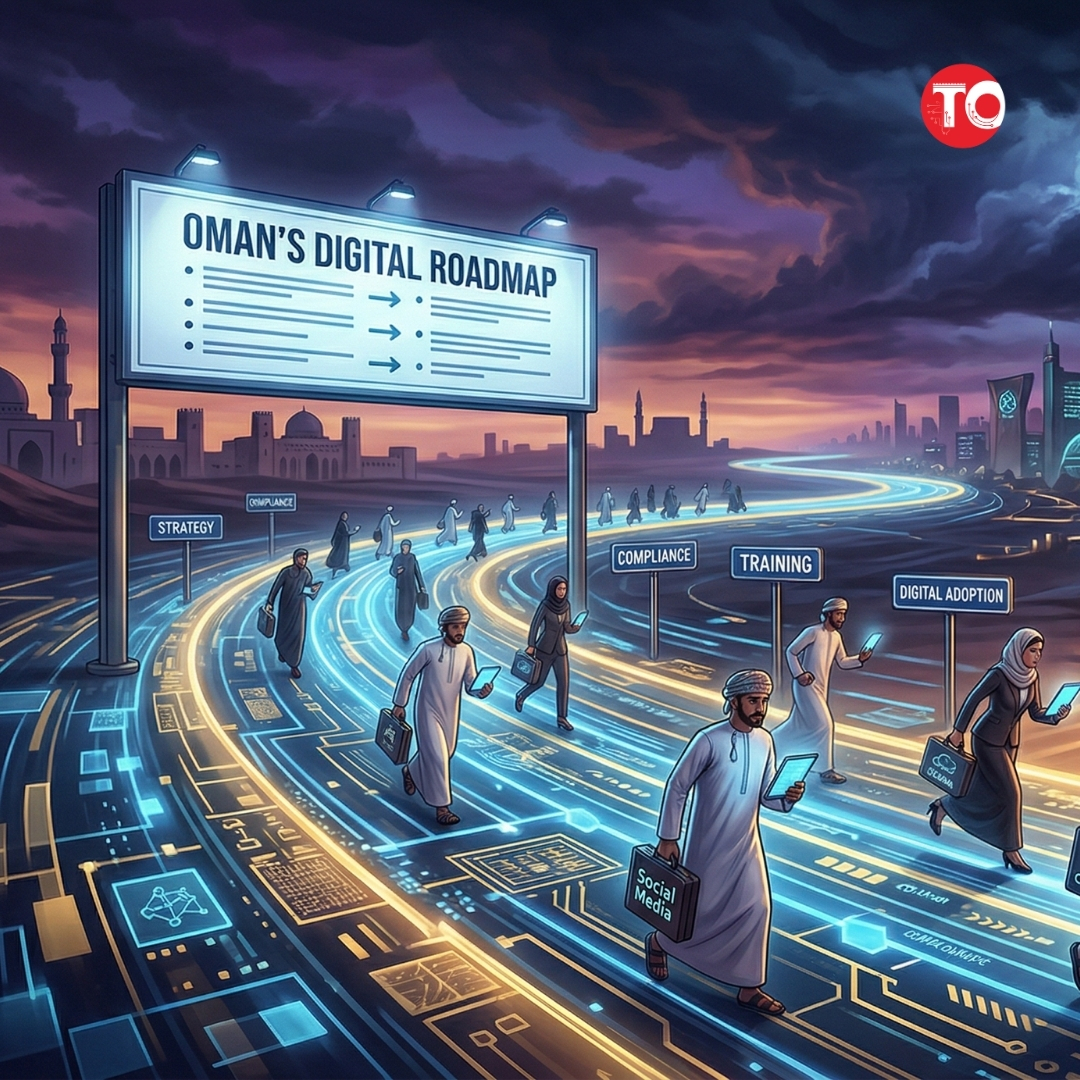
When MTCIT published its 2026–2030 digital economy roadmap on 10 March, I watched the reaction across Muscat. Most business leaders treated it the way they treat most national strategies: useful context, not a Monday morning priority.
That's usually a safe instinct. Policy documents come and go. This one is different, and the difference is worth naming.
The 2026–2030 roadmap isn't a strategy document. It's a schedule. National AI platform, sovereign cloud infrastructure, digital transformation centres in all 11 governorates — these are infrastructure commitments with dates attached, not aspirations. And running alongside them is Fawtara.
If you're a VAT-registered business in Oman and you haven't looked at Fawtara yet, that's the item I'd move to the top of the list this week.
Fawtara is the Oman Tax Authority's national e-invoicing platform, built on the international Peppol framework. The OTA became a certified Peppol Authority in January. Phase 1 goes live in August 2026 for the largest 100 to 150 VAT-registered taxpayers. Phase 2 follows in early 2027 for remaining large taxpayers. By mid-to-late 2027, every VAT-registered business in the country needs to comply.
That's the part most executives I've spoken with have not internalized. The conversation tends to go: "Yes, we heard about e-invoicing. Our accountant is looking at it." The accountant is looking at it, but the requirement is not an accounting update. Invoices must be generated in UBL 2.1 XML format with 53 mandatory fields per standard invoice, transmitted through an accredited Access Point. That means new infrastructure, not a new template.
Companies running on manual invoicing, basic spreadsheets, or older ERP systems without Peppol capability have roughly 18 months to decide whether they're upgrading their own systems or paying a service provider to handle the translation layer. Neither is cheap, and neither happens in a quarter.
The broader pattern is what makes this moment different from previous digital announcements. The first digital economy programme (2021–2025) actually delivered — RO 800 million in GDP contribution, 2,200 government services digitized, 48 million digital transactions in 2025, 16 places gained in global competitiveness rankings. The government built infrastructure, and now it's requiring businesses to use it.
MTCIT described the first phase as "establishment" and the second as "empowerment." I'd put it more directly: establishment was building the infrastructure. Empowerment is making everyone use it.
The second-order effects extend beyond Fawtara. Sovereign cloud requirements will shape vendor decisions for any company handling regulated data. The governorate digital centres will raise the bar for digital service delivery outside Muscat. The national AI platform will set new standards for how businesses interact with government systems — procurement, licensing, compliance.
The common assumption that these programmes primarily affect government entities and large enterprises is wrong. Fawtara alone proves it. Every VAT-registered business in the country is in scope within two years.
What I'd recommend to any business leader reading this:
Spend 30 minutes this week mapping your current invoicing infrastructure against Fawtara's Peppol requirements. If you discover you need to upgrade, you want that conversation with vendors starting now, not in Q3.
Look at where your operational data lives. If you're planning AI tools, SaaS platforms, or cloud migration in 2026, assume Omani data residency will be a hard requirement — not a future conversation.
Treat the roadmap as a planning input, not background reading. The companies best positioned in 2028 are making technology decisions this year that align with where the infrastructure is going. The ones scrambling will be the ones who treated each deadline as a surprise.
Oman is doing something most Gulf countries announce but few execute: converting digital policy into digital infrastructure, on a schedule. The window between "available" and "mandatory" closes in 2027.
That's the shift worth internalizing now.