

Are They Replacing Jobs or Redefining Leadership?
A Deep Dive into the Future of Work, Human Potential & AI Partnership
A Story You Might Relate To
Paula had been a marketing manager for 15 years. She knew her team, she knew her clients, and she knew her craft. Then one Monday morning, her company introduced an AI tool that could write ad copy, analyze customer data, and generate entire campaign ideas all in seconds.
Her first reaction? Fear.
Millions of people across the world are sitting exactly where Paula sat wondering if the machine beside them is slowly becoming their replacement. But here is what happened next in Paula's story, and what science is beginning to confirm: the AI didn't take her job. It changed how she did it.
The Real Story Behind the Fear
It's easy to understand why people feel threatened. A 2023 report by Goldman Sachs estimated that AI could automate tasks equivalent to 300 million full-time jobs globally. That number sounds alarming. But the same report revealed something rarely discussed: AI is more likely to augment roles than erase them entirely.
MIT economist David Autor, who has studied automation for over two decades, found that while machines do replace certain repetitive tasks, they also create new categories of work that didn't exist before. In fact, 60% of jobs people do today didn't exist in 1940. History keeps reminding us the technology shifts what we do, it rarely ends with what we're for.
"The question is not whether AI will change your job. It already is. The question is whether you'll be the one shaping that change or reacting to it."
What Science Actually Says
A landmark study published in Science (2023) observed how AI co-pilots affected the performance of 5,000 customer service agents. Workers who used AI assistance resolved 14% more queries per hour and showed significantly lower stress levels, especially newer, less experienced employees.
Why? Because AI handled the repetitive, information-heavy lifting. This freed the human agents to do what AI still cannot: listen with empathy, build trust, and make nuanced judgement calls. The science is clear; AI doesn't replace human intelligence, it amplifies it.
Neuroscience adds another layer. Our brains are wired for creativity, connection, and pattern-making at a higher level. The prefrontal cortex: the seat of leadership, planning, and emotional reasoning is uniquely human. AI cannot replicate it. It can only assist it.
Redefining What Leadership Looks Like
Here is where the real transformation lies. When AI handles data crunching, scheduling, and reporting, leaders are suddenly free. Free to think. Free to connect. Free to lead with intention rather than administration.
A McKinsey Global Institute survey (2024) found that leaders who adopted AI tools in their workflow reported spending twice as much time on strategic planning and team development; the parts of leadership that actually move organizations forward.
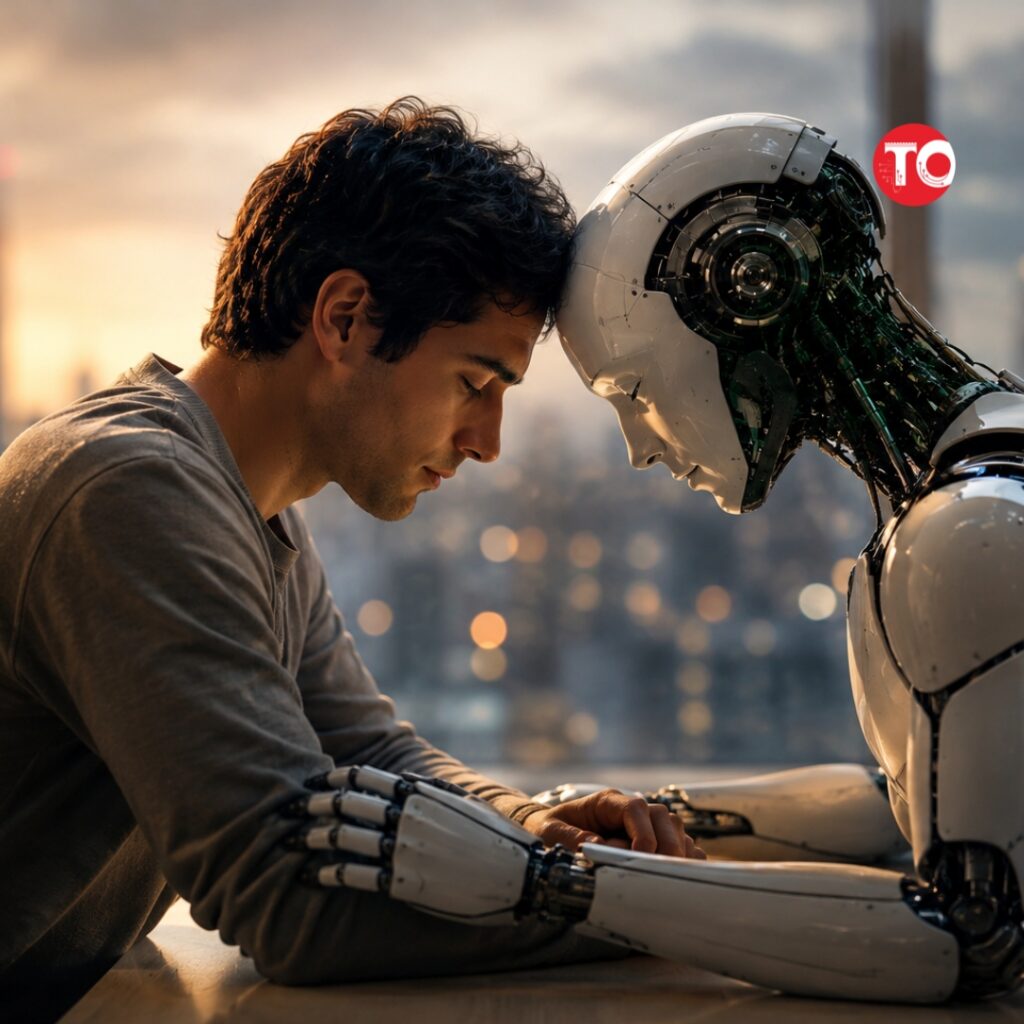
Think of it this way: if AI is the co-pilot, then you are the captain. A co-pilot doesn't fly the plane for you it handles the systems so you can focus on the destination, the passengers, and the decisions that truly matter.
Back to Paula. Within six months of using the AI tool, her team launched twice as many campaigns. Not because the AI did the work but because Paula had more time to mentor her team, build client relationships, and think creatively. Her leadership didn't shrink. It grew.
What this Means for You
Whether you're a teacher, a manager, a nurse, an engineer, or a small business owner, AI is coming to your world, if it hasn't already. And the response that will serve you best is not resistance. It's readiness.
The World Economic Forum predicts that 44% of workers' core skills will be disrupted in the next five years. But it also highlights that curiosity, adaptability, and emotional intelligence will become more valuable, not less. These are deeply human traits. Your traits.
The people who thrive won't be those who fear AI the most or trust it blindly. They'll be the ones who learn to work alongside it, directing it, questioning it, and using it to become sharper, kinder, and more effective versions of themselves.
A Promise Worth Making
Here is a promise worth holding onto; not from a machine, but from everything we know about human history and human resilience: you are not replaceable.
Your story, your instincts, your ability to sit with someone in their hardest moment, to inspire a team when morale is low, to make a call when the data isn't enough, none of that can be coded. None of that can be automated.
AI is a remarkable tool. But a tool still needs a hand that knows how to hold it wisely. That hand is yours.
A Final Reflection
The next time you feel uneasy watching an AI tool do something faster than you thought possible, pause. Take a breath. And remember Paula.
She didn't become less valuable when the AI arrived. She became more of who she already was; a leader, a mentor, a creative thinker because she finally had the space to be.
The real question was never 'Will AI take my job?' The real question is: 'Who will I become when it frees me from the parts of my job that were never really me?'
That is the question worth sitting on. And the answer that's entirely yours to write.