




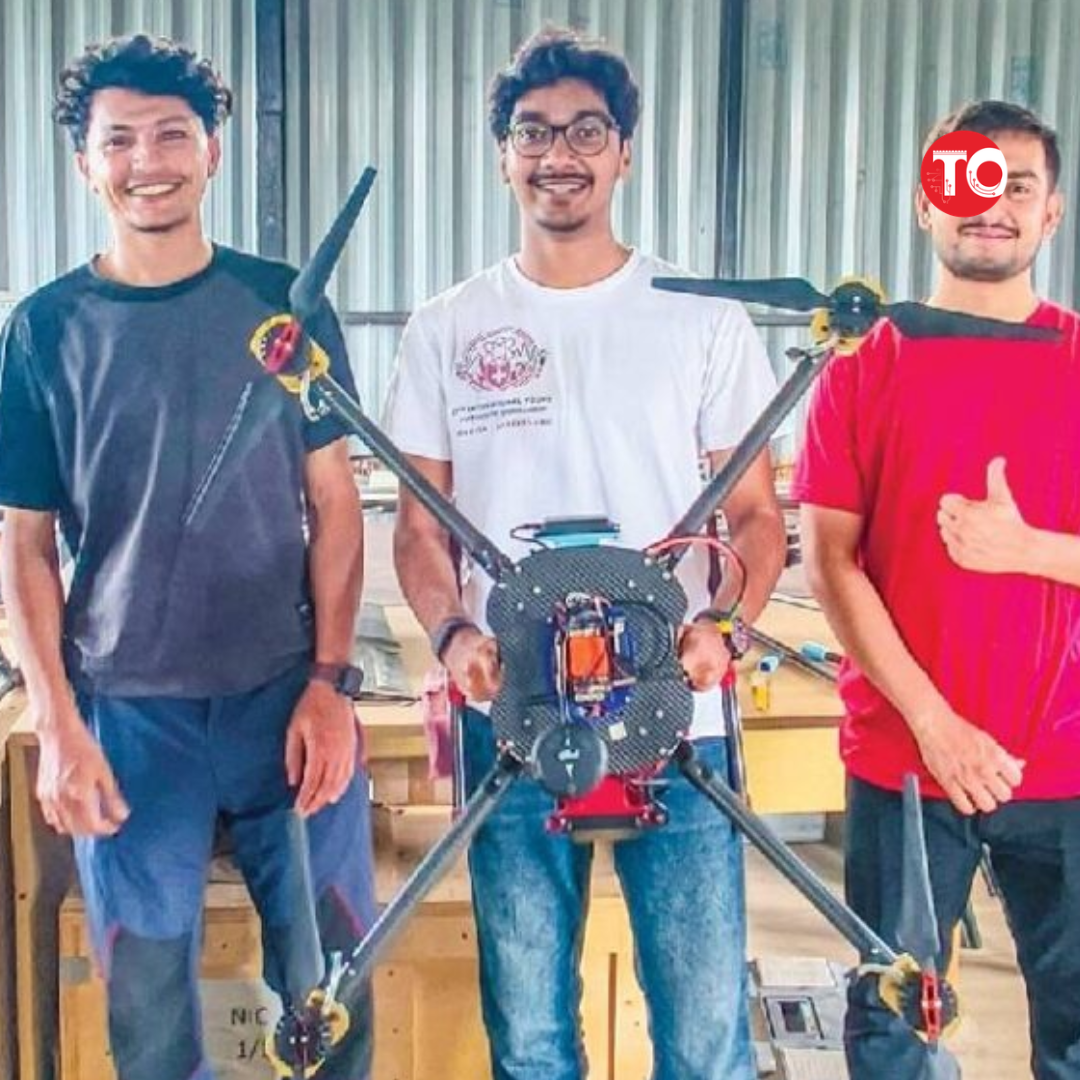
Muscat Student Innovates Drone-Guided Disaster Response System
Kabir Goel, a student at The British School Muscat, has engineered a drone-guided rescue robot system designed to assist emergency response teams in navigating hazardous disaster zones. Combining an overhead mapping drone with an autonomous ground rover, the dual-robot platform provides real-time situational awareness and ground-level execution in environments rendered inaccessible by floods or earthquakes. The project, which Goel developed and tested at Nepal’s National Innovation Center (NIC), has received international recognition and earned a 10-year utility model patent from the German Patent and Trade Mark Office.
Dual-Robot System Splitting Aerial Mapping and Ground Delivery
The system operates on a functional division of labor where aerial intelligence guides autonomous ground navigation:
- Aerial Terrain Mapping: A drone equipped with a Raspberry Pi unit captures high-resolution imagery to generate three-dimensional elevation models and identify debris obstacles in real time.
- Route Optimization: Custom algorithms process visual data to calculate the safest navigation path while avoiding abrupt turns or unstable terrain on rough ground.
- Autonomous Rover Execution: Guided by visual tracking markers from the overhead drone, the ground rover autonomously follows the mapped trajectory to reach isolated civilians and deliver critical emergency supplies.
Testing at Nepal National Innovation Center and Military Application
During an internship at Nepal's National Innovation Center under researcher Dipendra Basnet, Goel refined his pipeline to convert aerial photos into 3D topographical models, validating the algorithm against the international Hessigheim 3D benchmark. NIC General Manager Col Sanjay Jha (Retd) commended Goel's engineering design, confirming that the system is being adapted for operational evaluation by the Nepali Army's Disaster Response Unit. Additionally, Goel was honored at the "Celebrating Young Innovators" program hosted by the Ambassadors' Club Nepal in Kathmandu.
Local Relevance for Oman's Emergency Search and Rescue Operations
The technology holds significant potential for deployment in Oman, where severe weather, tropical cyclones, and flash wadi floods frequently isolate local communities and damage roads. Goel discussed the disaster-response system with Omani search-and-rescue officer Faisal Al Dhuhli, who noted its value for local emergency services pending field tests under Omani environmental conditions. Founder of the Oman Robotic Society, Goel aims to expand access to hands-on robotics education while developing hardware solutions for regional climate resilience.
Empowering Youth-Led DeepTech and Robotics in Oman
Ultimately, Kabir Goel’s drone-guided rescue system highlights the capability of young innovators in Oman to build impactful robotics solutions for global challenges. Fusing computer vision, aerial photogrammetry, and autonomous ground robotics creates a scalable model for modern search-and-rescue operations. As field testing progresses across both Nepal and Oman, youth-driven deeptech projects continue to align with national goals for technology adoption and human capital growth under Oman Vision 2040.