


I walked into a government service office in Muscat last month to process a permit for my book. The employee behind the counter could not figure out how to complete a basic task on his system. I pulled out my phone, opened ChatGPT, walked him through the solution in two minutes, and joked on my way out: "Next time, pay me."
That moment summarized the state of AI adoption in Oman better than any research report could.
The tools exist. The capability exists. The awareness does not.
I co-founded Devmate Solutions, an AI automation company operating across the GCC. We build AI agents for businesses: chatbots, sales automation, procurement intelligence, predictive maintenance, content production engines. Every week I sit across from business owners in Oman and pitch these solutions. What I hear back is consistently the same set of responses.
"We are not ready for AI yet."
"That sounds complicated."
"We will look into it next year."
"Our team would not know how to use it."
None of these are technical problems. They are perception problems. And perception problems are the most expensive kind because they feel reasonable while the market moves without you.
The Awareness Gap
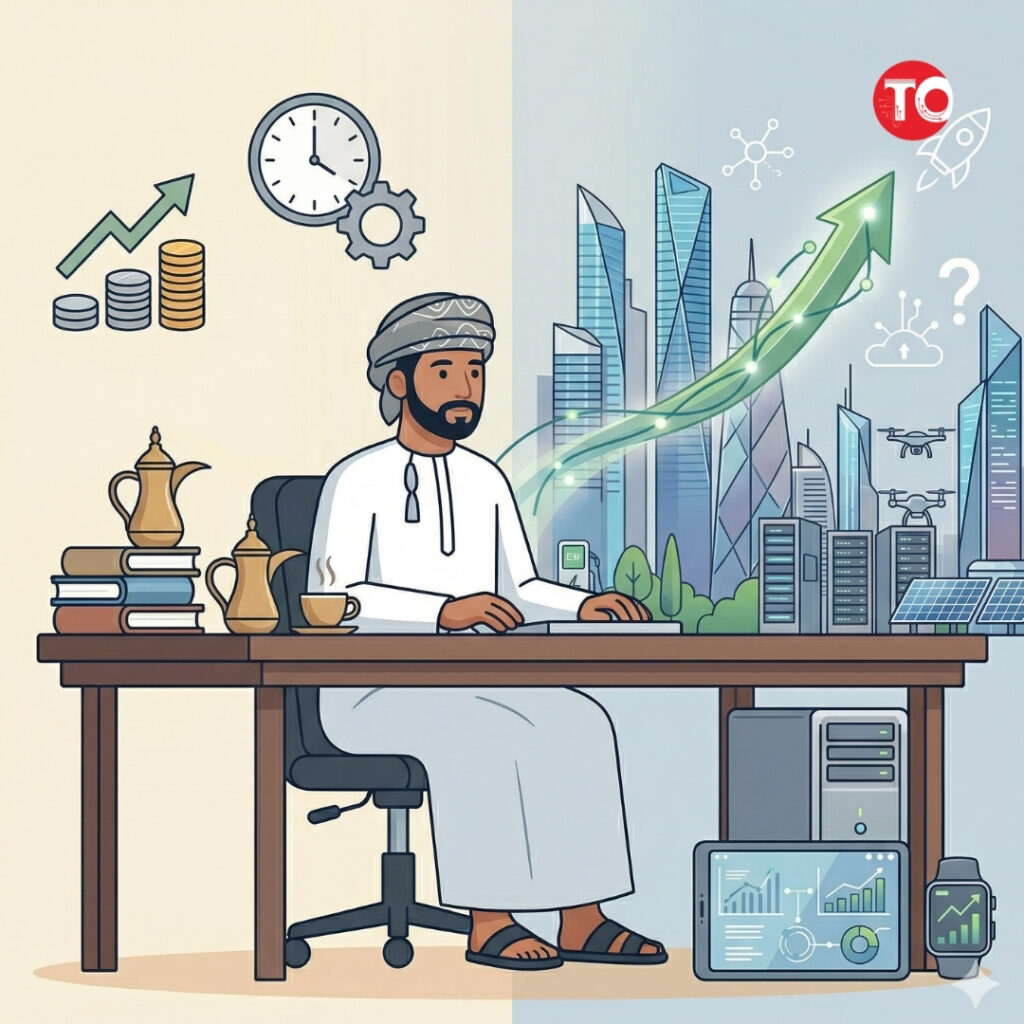
Most Omani business owners I meet do not reject AI. They simply do not understand what it can do today. Their mental image of AI is still science fiction. Robots replacing humans. Complex systems that require a team of engineers. Millions of rials in investment.
The reality is different. An AI chatbot that handles customer inquiries 24 hours a day costs less than one employee's monthly salary. A sales pipeline AI that follows up with every lead automatically costs less than the revenue lost from one forgotten customer. A content engine that produces 40 images and 15 videos per month costs less than one agency retainer.
But when I explain this, the first reaction is usually silence. Not resistance. Confusion. They have never seen it work in their own context. They have never seen an Arabic-speaking AI agent handle a customer conversation. They have never seen a procurement system that compares vendor pricing automatically.
They cannot adopt what they cannot visualize.
The Language Barrier Nobody Talks About
Here is something the global AI conversation ignores entirely: most AI tools are built in English for English-speaking markets. The GCC operates in Arabic. Gulf dialect. Formal Arabic. Mixed Arabic and English in the same sentence.
When an Omani business owner tries a chatbot built for the American market, it feels foreign. It does not understand how his customers speak. It does not understand the cultural context of a sales conversation in the Gulf. So he concludes that AI does not work for his business.
He is wrong. The AI works. The implementation was wrong.
What Oman needs is not more awareness campaigns about AI. It needs Arabic-first AI tools built for GCC business culture. Tools that understand the market, the language, and the way business actually gets done here.
This is exactly what we are building at Devmate. Not because we read a trend report. Because we sat in the rooms where the gap was visible.
The Cost of Waiting
The businesses that tell me "we will look into AI next year" do not realize what that delay actually costs.
Their competitor in Dubai is already using AI to respond to every lead within 30 seconds. Their competitor in Riyadh is already using predictive maintenance to prevent factory downtime. Their competitor in Abu Dhabi is already producing content at 10 times the speed and a fraction of the cost.
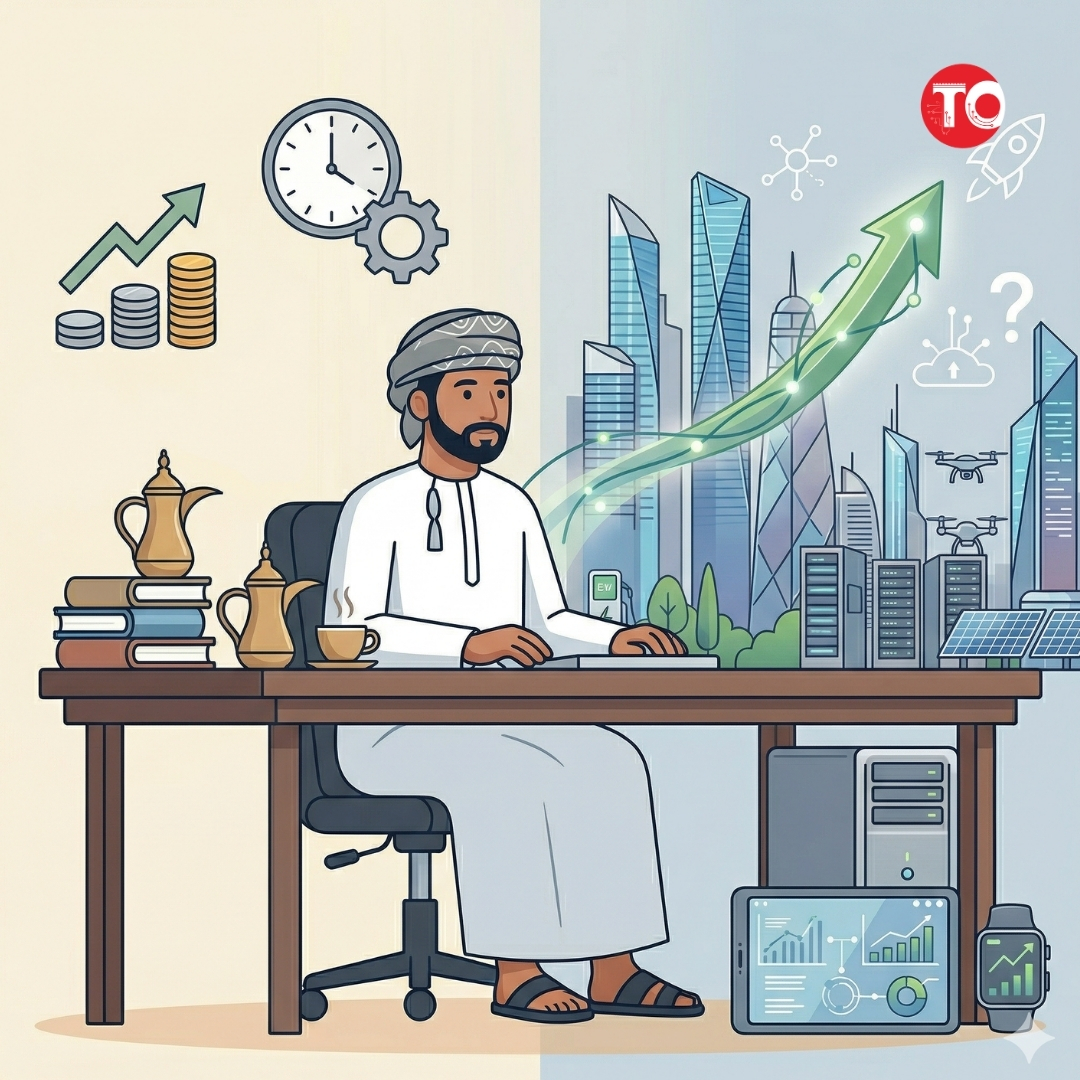
Oman's Vision 2040 puts technology and digital transformation at the center of national strategy. The government is moving. The infrastructure is being built. But the private sector adoption is lagging behind because individual business owners are still thinking about AI as a future decision rather than a present necessity.
Every month of delay is a month where competitors build advantage. AI does not wait for committees to approve budgets. It compounds for whoever installs it first.
What Actually Needs to Change
I have spent the last several months pitching AI solutions to Omani businesses of all sizes. From sovereign-backed manufacturers to small retail shops. The pattern is clear. Three things need to change for AI adoption to accelerate in Oman.
First, demonstration over explanation. Business owners do not need another article about AI potential. They need to see a working AI agent handle a customer conversation in Arabic, live, in front of them. We started doing live demos and the conversion rate changed overnight. Seeing is believing. Talking is noise.
Second, local solutions for local problems. Importing a Silicon Valley AI product and dropping it into an Omani business does not work. The language is wrong. The cultural context is missing. The support is in a timezone 12 hours away. Oman needs AI companies building from inside the market, not selling into it from outside.
Third, entry pricing that removes the excuse. If AI costs 50,000 rials, only large enterprises will adopt. If AI costs 500 rials per month, every business with a website and a WhatsApp number becomes a potential client. The barrier to adoption is not technology. It is pricing architecture. Make it accessible and the market opens.
The Builders Will Win
Oman is not behind because it lacks talent. It is behind because the bridge between AI capability and business application has not been built yet. The companies building that bridge right now will own the market for the next decade.
I am not writing this as an observer. I am writing this as someone in the middle of it. Every day my team and I sit across from businesses that need AI but do not know it yet. Our job is not to sell them software. Our job is to show them what is already possible and make it accessible.
The question for every business owner reading this is simple: while you are deciding whether AI is ready for your business, your competitor is deciding how many AI agents to deploy this quarter.
The tools are here. The cost is accessible. The only thing missing is the decision.
And decisions that come late rarely come cheap.