



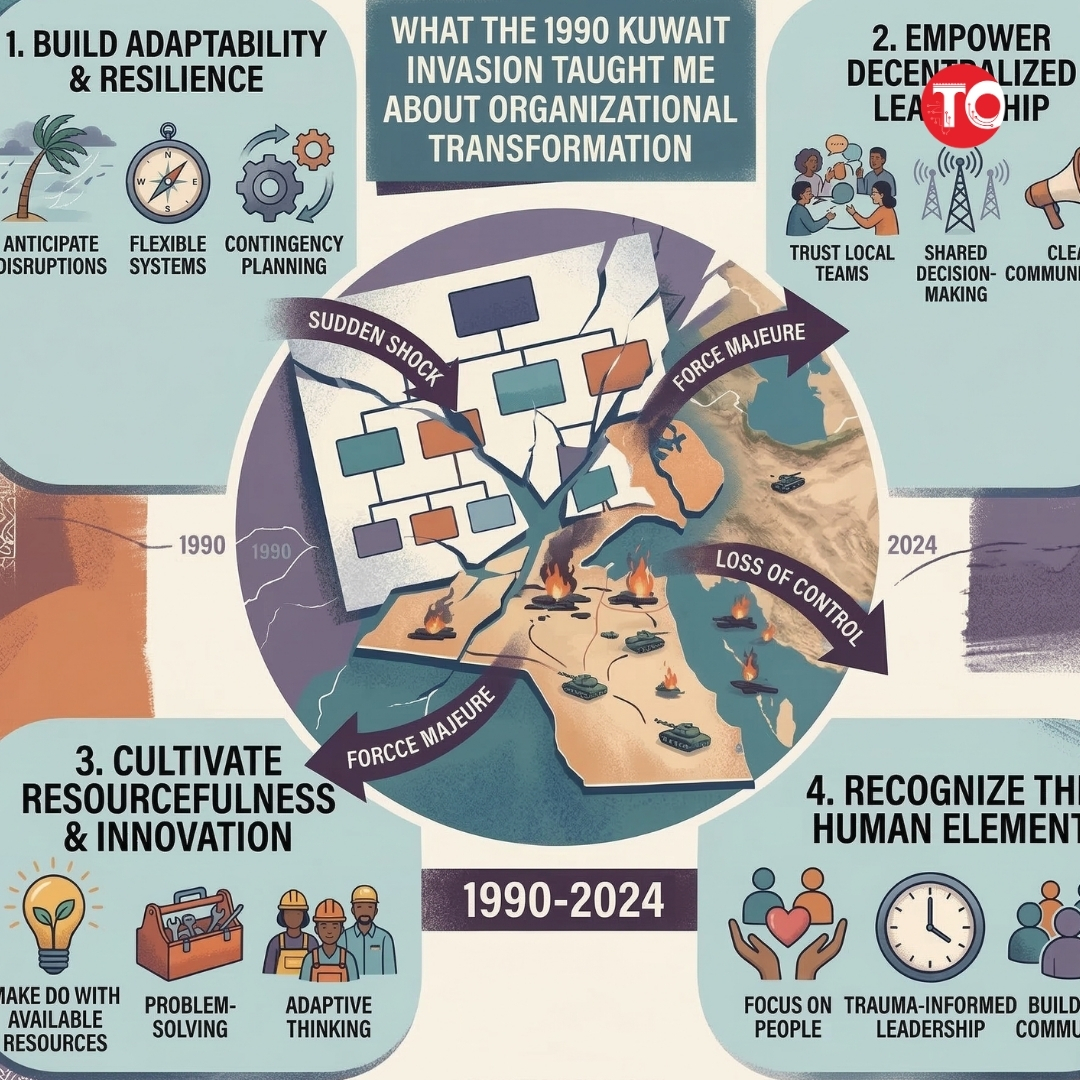
I was seven years old when Iraqi tanks rolled into Kuwait City.
Within hours, everything my parents had built over fifteen years was gone. The business. The home. The savings. We became refugees overnight - displaced to a country we barely knew, starting from zero.
What I watched my parents do next shaped everything I believe about transformation today.
They didn't chase quick wins. They didn't optimize. They stabilized.
My father didn't rush to rebuild the business. He secured shelter first. Then income. Then stability for us kids. Only after the foundation was solid did he start thinking about growth.
It took years. But what they rebuilt lasted.
• • •
The Pattern I Keep Seeing
Twenty years into my career - across Huawei, Motorola, SuperJet Oman, and $95M+ in transformation portfolios - I see the same mistake everywhere.
Organizations under pressure do the opposite of what my parents did.
They're told to scale. Optimize. Adopt new technology. Move faster. So they try to optimize systems that were never structurally stable in the first place.
And when you optimize an unstable system, you don't get performance. You get chaos. Amplified.
Execution breaks down. Complexity multiplies. The same problems keep resurfacing with different names. Teams burn out fighting fires that shouldn't exist.
Sound familiar?
• • •
The Real Sequence
Here's what I've learned: Stabilization must come before optimization.
Most organizations have it backwards. They chase performance before they've built the structure to hold it. They scale before they have clarity. They adopt AI before their human operating system is functioning.
The result? Transformation initiatives that fail. Not because the strategy was wrong. Not because the technology was bad. But because the foundation was never stable.
Stability precedes performance. Every time.
What Stabilization Actually Means
Stabilization isn't about slowing down. It's about sequencing correctly.
It means: Do your teams actually agree on definitions - or does "governance" mean three different things to three different departments?
It means: Are your processes structurally sound - or are they held together by heroic individuals who compensate for broken systems?
It means: Is your organization clear on what it's doing and why - or is everyone busy with activity that doesn't connect?
When the structure is stable, organizations can scale faster, execute better, and adopt innovation without creating systemic confusion.
When it's not, every optimization attempt just amplifies the underlying instability.
• • •
Crisis Forces Clarity
My parents didn't have the luxury of confusion. The crisis forced them to see clearly. To prioritize ruthlessly. To stabilize before they optimized.
Most organizations don't face that kind of crisis. So they never get that clarity.
They keep circling. Keep optimizing broken systems. Keep wondering why transformation doesn't stick.
The answer isn't more strategy. It's not better tools. It's not another consultant with another framework.
The answer is simpler and harder: Fix the structure before you chase performance.
Stabilization before optimization. Clarity before scale.
That's what a seven-year-old refugee learned watching his parents rebuild from nothing. And it's proven true in every boardroom, every procurement overhaul, every digital transformation I've touched since.