



Why self-reliance
is the foundation
of everything.
Oman's Small and Medium Enterprise sector carries one of the most important roles in the country's future. The strength of any nation's economy ultimately comes from within — from the ingenuity, the ambition, and the capability of its own people building their own enterprises, solving their own problems, and competing on the world stage on the strength of skill and knowledge.
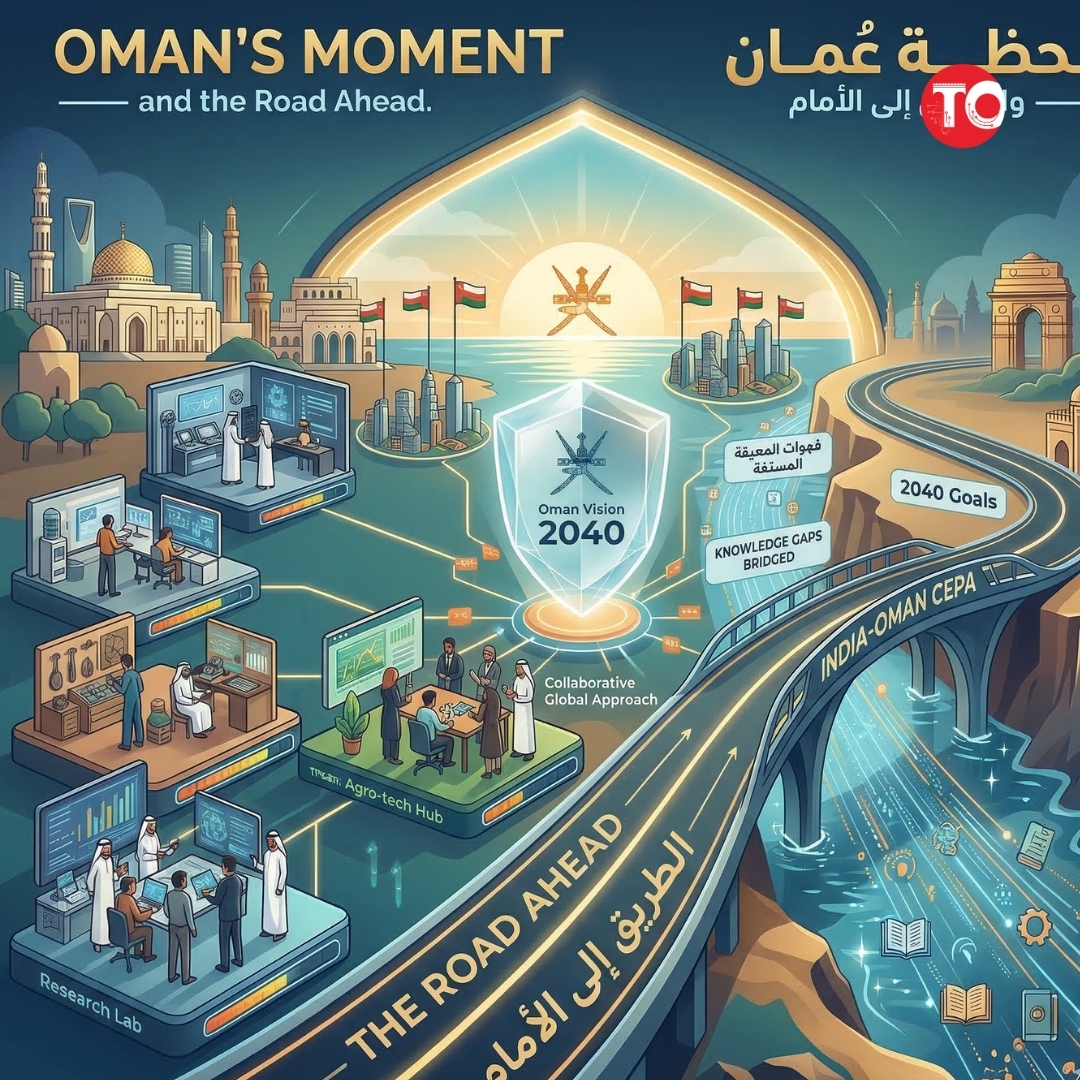
This philosophy of self-reliance sits at the heart of Oman Vision 2040. The vision recognises that an economy dependent on a single resource — no matter how valuable — is inherently fragile. The only durable alternative is an economy where thousands of Omani entrepreneurs, innovators, and skilled professionals are creating real value, generating employment, and competing in global markets on the strength of knowledge and capability.
Oman's SME development institutions — with their programmes in incubation, mentorship, financing access, skill training, and market promotion — are designed to build exactly that. Every Omani entrepreneur who succeeds, every small business that grows, every young person who learns a technology skill and turns it into a livelihood: this is what a self-reliant Oman looks like in practice.
The question this article explores is simple: in a world changing at an extraordinary pace — in technology, in manufacturing, in digital trade, in the use of AI, drones, robotics and advanced systems — what more can Oman's SME sector access, learn, and build? And how can the wider world help?
A door was opened
in December 2025.
What lies beyond it?
"India and Oman share a vision of a future built on knowledge, innovation, and the strength of our people. CEPA is our commitment to building that future together."
When Prime Minister Narendra Modi arrived in Muscat in December 2025 — accompanied by India's Foreign Minister, Commerce Minister, and National Security Advisor — it was not a routine diplomatic visit. It was a declaration. India was sending its most senior team to say clearly: Oman is a strategic priority.
The Comprehensive Economic Partnership Agreement (CEPA) signed during that visit is the most significant economic agreement between the two countries in 70 years of relations. It gives Indian goods nearly unrestricted access to the Omani market. It opens Oman's services, technology, research, and educational sectors to Indian institutions. It creates a formal framework for cooperation in digital trade, manufacturing, clean energy, food security, space, and critical minerals.
But CEPA is only a framework. A framework is an empty room. What fills that room — the programmes, the knowledge exchanges, the business partnerships, the skill development, the joint innovation — is what will determine whether CEPA becomes a transformative chapter in Oman's development story, or remains a signed document gathering dust.
For Riyada, CEPA is not primarily about large trade flows between big companies. It is about the smaller question: how can Oman's SME community access the knowledge, technology, mentorship, and market connections that India — and the wider global innovation ecosystem — can offer? That is where the real opportunity lives.
What Oman's
businesses are
missing.
It would be unfair to frame this as a weakness. Omani entrepreneurs are resourceful, ambitious, and deeply committed to their country's growth. The challenge is not one of willingness. It is one of access — access to the knowledge that the world is generating at speed, access to the global networks that connect innovators to each other, and access to the practical skills and tools that make technology real rather than theoretical.
Several gaps stand out consistently when looking at Oman's SME landscape through the lens of what Vision 2040 demands:
Gap 01
Technology Literacy & Adoption
Most Omani SMEs are aware that technologies like AI, drones, automation, and data analytics exist. Far fewer know how to evaluate, procure, deploy, or build businesses around them. The gap between awareness and practical adoption is wide — and it is widening as global technology accelerates.
Gap 02
Skilled Workforce for New Industries
Oman Vision 2040 identifies drones, advanced manufacturing, logistics technology, space applications, and digital services as priority sectors. But growing a sector requires people trained to work in it. Certified drone pilots, AI engineers, robotics technicians, digital forensics specialists — these skills are in short supply and growing demand.
Gap 03
Intellectual Property Awareness
When Omani entrepreneurs innovate — whether in technology, design, heritage products, or services — they often have no framework for protecting and monetising what they create. IP protection, patent filing, licensing, and the use of GI (Geographical Indication) tagging for traditional products are almost universally underdeveloped.
Gap 04
Global Networks & Market Access
Oman's SMEs largely operate within the domestic market. Under CEPA and Oman's growing trade agreements, the potential to access Indian, South Asian, and global markets is now real. But access requires relationships — with distributors, platforms, investors, and buyers — that most Omani businesses simply don't yet have.
Gap 05
Quality Standards & Certification
Competing globally means meeting global quality standards. Many Omani SMEs produce good products and services but lack the quality certification frameworks — ISO standards, product certifications, process documentation — needed to be taken seriously by international buyers and investors. This is a solvable problem with the right knowledge transfer.
Gap 06
Exposure to Global Innovation Pace
Technology is evolving faster than any single country can track alone. Breakthroughs in drone technology, space applications, counter-drone systems, AI in manufacturing, robotics in agriculture — these are happening globally and the knowledge is not automatically reaching Oman's entrepreneurs. Structured knowledge exchange programmes are the missing link.
Where the learning
needs to happen.
These are not academic subjects. They are practical domains where global knowledge, combined with Omani ambition and Riyada's infrastructure, can produce real businesses, real jobs, and real economic impact.
Drone Technology — Operations, Manufacturing & Regulation
Drones are not a niche technology — they are rapidly becoming infrastructure. In agriculture (precision spraying, crop monitoring), in logistics (last-mile delivery, port management), in infrastructure inspection (oil pipelines, coastal monitoring), in construction, and in public safety — the applications are vast and growing. Oman's agriculture, fisheries, logistics, and construction sectors are all natural adopters. What is needed: certified pilot training aligned to international standards (EASA, DGCA), practical knowledge of drone deployment in each sector, understanding of regulatory frameworks, and awareness of how Drone-as-a-Service models create business opportunities for SMEs without requiring full ownership of expensive equipment.
AI, Machine Learning & Smart Systems for Industry
Artificial Intelligence is not a future technology — it is already reshaping how businesses in every sector operate. For Oman's SMEs, the most relevant applications are practical: AI for quality control in manufacturing, predictive maintenance for equipment, demand forecasting for retail and logistics, Arabic-language customer service tools, and AI-assisted agricultural planning. The knowledge gap here is not about understanding AI theoretically — it is about knowing which tools exist, how to evaluate them, how to deploy them at SME scale, and what local and international partners can provide them.
Advanced Manufacturing — 3D Printing, Robotics & Prototyping
Oman Vision 2040 targets manufacturing as the sector with the most transformation potential — growing from 10% to 21% of GDP. But modern manufacturing is not the factory of 30 years ago. It is 3D printing reducing time-to-market from months to days. It is robotics making small-batch production economically viable. It is parametric design enabling traditional Omani craft products — khanjar, silverware, frankincense packaging, textile patterns — to be modernised, standardised, and exported at scale. Omani SMEs need exposure to these tools, practical training on using them, and understanding of how they change the economics of manufacturing entirely.
Space Technology — Applications for Oman's Economy
Space is no longer the domain of a handful of superpowers. Satellite data, remote sensing, GPS applications, and space-based communications are now accessible commercial technologies — and they have direct applications for Oman's priority sectors. Satellite imagery for agricultural monitoring. Remote sensing for coastal and fisheries management. GPS-enabled drone logistics networks. Climate data for water management. Space-grade sensors for infrastructure monitoring. Oman's geography — coastline, deserts, mountains, strategic waterways — makes it an ideal candidate for space-enabled applications. Awareness and education are the first step.
Digital Trade, E-Commerce & International Business Law
CEPA explicitly includes digital trade provisions. This creates a real, immediate opportunity for Omani SMEs to sell their products and services to Indian and international markets through digital channels. But doing so successfully requires knowledge that most Omani businesses currently lack: how digital trade platforms work, what the legal obligations are, how to price, ship, and handle returns internationally, how to navigate digital payments (UPI, RuPay, and Gulf payment gateways now linked under CEPA), and what cross-border data regulations require. International commercial law, contract structuring, and dispute resolution are equally important and equally underdeveloped.
Cyber Security & Digital Forensics
As Oman's economy digitalises — as businesses move online, as drones and sensors are deployed across industries, as smart infrastructure is built — cyber security becomes a foundational requirement, not an optional add-on. For SMEs, the risk is real and often underestimated: data breaches, ransomware, digital fraud, drone-related security incidents. Digital forensics — the ability to investigate, document, and respond to digital crimes — is a growing professional discipline with direct applications in law enforcement, regulatory compliance, and business continuity. Awareness, training, and practical tools are all needed.
Knowledge does not
belong to any one country.
India is the most natural starting point, for obvious reasons: CEPA has just been signed, 675,000 Indians live in Oman and represent a natural bridge, and India has built one of the world's most dynamic technology and innovation ecosystems in the past two decades — including a world-leading drone industry, 200,000+ registered startups, world-class research universities, and globally respected institutions in manufacturing quality, digital trade, and innovation policy.
But the vision here is broader than India alone. The world's knowledge on drone technology, space applications, advanced manufacturing, cyber security, and entrepreneurship is distributed globally — across European think tanks, American technology OEMs, Asian manufacturing leaders, and emerging innovation hubs everywhere. What Oman's SME community needs is not just an India connection, but structured, curated access to global knowledge and global networks.
The most effective model for this is not a trade mission or a one-time conference. It is a sustained, regularly refreshed Global Knowledge Exchange Programme — bringing world-class knowledge holders directly into Oman's business community through workshops, immersive learning sessions, expert residencies, and peer-to-peer networks that persist long after any single event ends.
Drone Technology:
India's drone industry has grown from zero to 270+ companies in a decade, driven by government policy (PLI scheme, DGCA regulations, iDEX defence grants) and an active research community across IITs. Europe's EASA regulatory framework is the global gold standard. Together, they offer Oman both the technology and the regulatory architecture to build its own certified drone sector.
Manufacturing Quality:
India's ZED (Zero Defect Zero Effect) Certification Scheme has helped 65,000+ MSMEs upgrade their quality and processes. German and Japanese manufacturing quality standards are globally benchmarked. What Oman needs is a structured quality upgrade pathway — drawing on proven models — that prepares its SMEs for global supply chains and export markets.
Space Applications:
India's ISRO has become a global benchmark for cost-effective space technology. Private Indian space companies, alongside global OEMs in satellite, remote sensing, and space communications, offer direct applications for Oman's agriculture, fisheries, water management, and infrastructure sectors. This is accessible, practical, and commercially relevant today.
Entrepreneurship Systems:
India went from a resource-dependent economy to the world's third-largest startup ecosystem in two decades. It did so through a combination of world-class research institutions (IITs, IIMs), government-backed incubation (NITI Aayog's Atal Innovation Mission), access to capital (SIDBI, DPIIT), and a culture of entrepreneurship that can be studied and selectively adapted. The Silicon Valley model and the Israeli innovation ecosystem offer equally relevant lessons.
Cyber & Digital Security:
India's growing cyber security sector, combined with global NGOs and research foundations working on digital forensics and crime research, offers Oman both the training frameworks and the practical tools to build digital safety infrastructure. This is particularly relevant as Oman's drone, IoT, and digital trade sectors all generate new cyber security requirements.
A Global Knowledge
Exchange for Oman.
The Oman Global Knowledge & Innovation Exchange (OGKIE)
The idea is straightforward: create a structured, recurring programme that brings world-class knowledge holders into direct contact with Oman's SME community. Not a one-off conference. Not a trade fair. A curated learning programme that runs regularly, builds a community over time, and systematically fills the capability gaps identified above.
Each session focuses on one domain — drones, AI in industry, 3D manufacturing, space applications, digital trade law, cyber forensics, quality standards, entrepreneurship systems. Each session brings 2–4 global experts: practitioners from India, Europe, the US, Asia — not academics lecturing, but people who have built real things and can share real knowledge.
Sessions are delivered in English and Arabic. Workshops are hands-on where possible. Participants leave with practical knowledge, global contacts, and a clear sense of what steps they can take next in their own business or career.
Over time, this becomes Oman's premier knowledge pipeline — connecting its SME community to the world's best thinking on the technologies and practices that matter most for Vision 2040.
The sessions of this programme would not be limited to Indian knowledge — they would draw from wherever the best thinking is. Belgium's drone think-tank community. American space OEMs. German manufacturing quality specialists. Israeli cyber security practitioners. Japanese robotics innovators. Singaporean digital trade lawyers. And yes — India's extensive drone industry, manufacturing quality ecosystem, and startup infrastructure, which happen to be among the most practically relevant for Oman's current situation.
This is not about geography. It is about getting the right knowledge to the right people at the right time — in Muscat, in Arabic and English, in a format that actually changes what participants do next.