



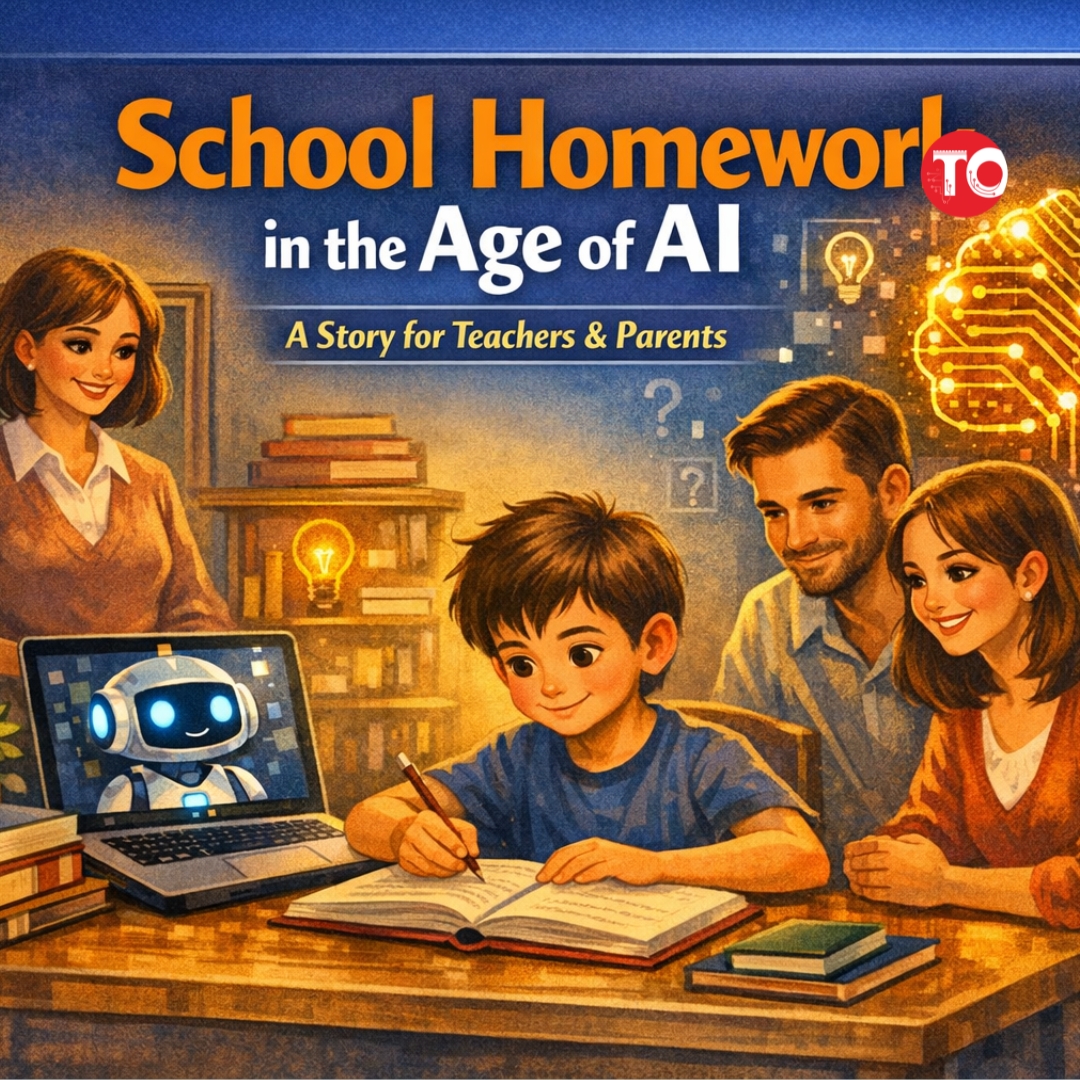
It was a quiet evening when Mrs. Sharma, a Class 5 teacher, was checking homework notebooks. Page after page looked perfect—neatly written, well-structured answers, even better than what she had explained in class.
At first, she felt proud.
Then she paused.
“Something feels different,” she said to herself.
The next day, she asked a simple question in class, something related to the homework. To her surprise, many students struggled to answer.
Later that evening, Ravi’s mother knocked on her door.
“Ma’am,” she said gently, “Ravi used an AI tool to complete his homework. It gave him all the answers. I didn’t realise this could be a problem.”
Mrs. Sharma smiled. “It’s not a problem,” she replied, “but it is something we must understand together.”
The New Reality
Today’s children are growing up in a world where artificial intelligence can answer almost any question in seconds. Homework that once took hours can now be done in minutes.
For parents and teachers, this is both exciting and worrying.
- Exciting, because children have access to unlimited knowledge
- Worrying, because learning may become weaker if AI does the thinking
But the truth is simple: AI is not the enemy. It is how we use it that matters.
The Real Purpose of Homework
Mrs. Sharma later explained this to her class:
“Homework is not just about getting the right answer. It is about:
- Thinking on your own
- Making mistakes and learning from them
- Building confidence
- Understanding concepts deeply
If AI gives you the answer, but you don’t understand it, then real learning is missing.”
The children listened quietly. Ravi raised his hand.
“Ma’am, can we still use AI?”
Mrs. Sharma smiled. “Yes, but wisely.”
A Balanced Approach for Parents and Teachers
This small incident led Mrs. Sharma to work closely with parents. Together, they created a simple approach.
For Teachers:
- Teach AI literacy: when and how to use it
- Ask open‑ended questions that require reasoning
- Encourage discussions, not just written answer
- Reward thinking process, not just the final answer
AI should become a thinking mirror, not a thinking machine.
For Parents:
Many parents see their children finishing homework quickly and feel relieved.
But learning is not about speed.
It is about effort, confusion, mistakes and recovery
- Sit with your child while they use AI
- Allow productive struggle—do not rush to AI
- Set simple rules: AI comes after thinking, not before
- Ask them to explain the answer in their own words
Remember: A slow-thinking child today becomes a strong-thinking adult tomorrow.
For Children:
- First try yourself
- Then use AI to check or improve
- Always understand what you write
A New Kind of Homework
A week later, Mrs. Sharma gave a different homework:
“Use an AI tool to learn about ‘plants’. Then write what you understood in your own words and draw one plant you like.”
This time, when she checked the notebooks, she saw something different.
Not perfect answers—but real thinking.
Some answers were simple. Some had small mistakes. But every child could explain their work confidently.
Mrs. Sharma smiled again—this time with complete satisfaction.
The Final Thought
The age of AI is not about replacing learning—it is about reshaping it.
For teachers and parents, the goal is not to stop children from using AI but to guide them to use it wisely.
Because in the end, education is not about perfect homework.
It is about growing minds.
And no machine can replace that.