




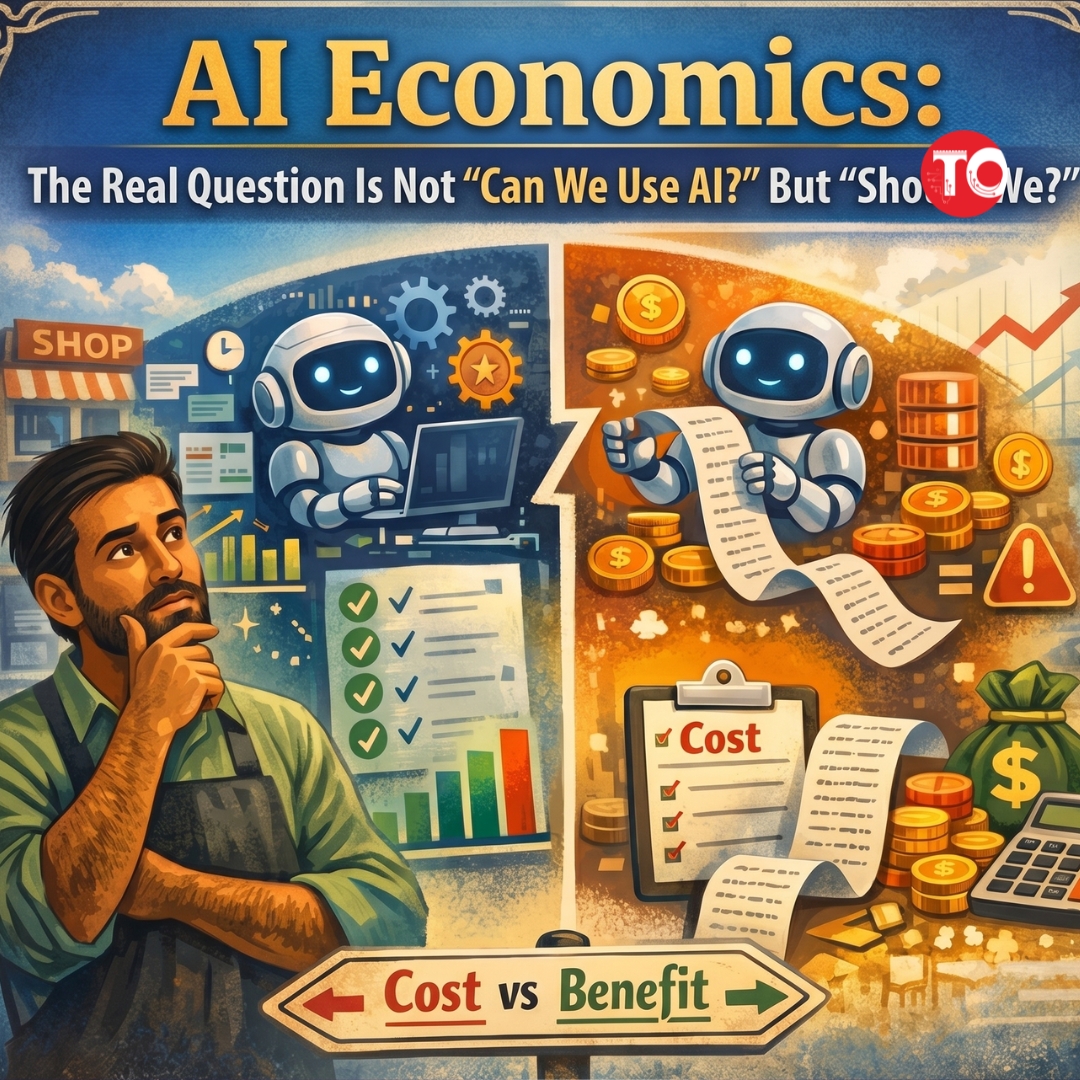
One evening, a small shop owner named Rohan stood in his quiet store after closing time. He had spent the day reading articles about artificial intelligence.
“AI can increase productivity.”
“AI can reduce costs.”
“AI is the future.”
Inspired—and slightly overwhelmed—he asked himself a simple question:
“Should I use AI in my business?”
This is where AI economics begins.
The AI Myth: Intelligence Is Expensive, So It Must Be Valuable
Many beginners assume that AI is always worth it because it is “smart.” But economics teaches us something important: value is not about intelligence alone—it is about cost versus benefit.
Think of AI like hiring a very fast assistant who works 24/7. Sounds great, right?
But this assistant charges you every time you ask a question, every time it analyses data, and every time it produces an answer.
So, the real question becomes:
Is the value created by AI greater than the cost of using it?
The Hidden Costs Nobody Talks About
Rohan soon realised AI costs are not just about buying software.
AI economics looks at total cost, including:
- Data collection and cleaning
- Computing power (cloud or servers)
- Integration with existing systems
- Skilled people to manage or review results
- Ongoing usage costs (every query, prediction, or response)
Suddenly, AI didn’t feel “cheap”. It felt metered, like electricity—use more, pay more.
When AI Makes Economic Sense
AI works best when it replaces or enhances repetitive, highvolume, predictable tasks.
Examples:
- Analysing thousands of customer tickets
- Forecasting demand using years of historical data
- Monitoring networks for anomalies
- Automating basic customer support queries
In these cases, AI reduces:
- Human effort
- Time taken
- Error rates
Here, AI economics is positive: lower longterm cost, higher output.
When AI Does Not Make Economic Sense
AI struggles economically when:
- The task is rare or oneoff
- Data is poor or unavailable
- Human judgement and context are critical
- The cost of mistakes is very high
Using AI for such tasks may look modern—but it often costs more than traditional methods.
Rohan realised something important: “If I only need this decision once a month, why pay AI every day?”
The Core Economic Principle of AI
At its heart, AI economics follows one simple rule:
If AI reduces the cost of doing something that matters at scale, it is worth it.
If it merely adds intelligence without reducing cost or increasing value, it is not.
AI primarily lowers the cost of prediction—predicting demand, behaviour, failures, or outcomes. Once prediction becomes cheap, humans can focus on judgement and action.
A Simple AI Economics Checklist
Before using AI, ask:
- Am I doing this task frequently?
- Do I have reliable data? Outlier ?
- Is the output scalable across many cases?
- Will AI reduce cost, time or risk measurably?
- Can I clearly explain the return on investment?
If most answers are “yes”, AI makes economic sense.
The Ending Rohan Didn’t Expect
Rohan didn’t deploy AI everywhere.
He used it in one place—demand forecasting.
Sales improved, waste reduced and costs dropped.
AI wasn’t magic.
It was economics, applied intelligently.
And that is the real secret of AI adoption:
Not excitement. Not fear. But clear economic thinking.