




How treating them the same is costing you more than you think
Imagine you've built something that genuinely solves a real problem. Your pipeline has two prospects: a fast-moving 40-person startup and a slow-deciding 3,000-person enterprise. You send them the same pitch deck, the same proposal, and the same onboarding flow.
One goes quiet. The other churns in six months.
The product didn't fail them. Your segmentation did.
The Costly Assumption
In B2B, the most expensive mistake an organization can make is treating all business customers the same. They aren't. A startup buying to move fast is an entirely different world from a corporate procurement team buying to reduce risk.
When your message doesn't match their reality, they don't complain. They just leave. According to Gartner, 53% of B2B deals stall not because of price, but because the conversation wasn't aligned with what the economic buyer actually cared about.
Think about that for a second. More than half of your pipeline isn't dying from competition or budget constraints. It's dying from misalignment. You're speaking to the wrong priorities, at the wrong altitude, using the wrong proof points. That isn't just a sales failure. It's an organizational failure to define your Ideal Customer Profile (ICP).
Meanwhile, the businesses getting this right? They're winning. Research shows that 73% of B2B companies using advanced customer segmentation exceed their revenue targets, and companies excelling at customer experience grow revenues 4 to 8% above market. The gap between winners and losers isn't product quality. It's precision.
It Starts With the Canvas
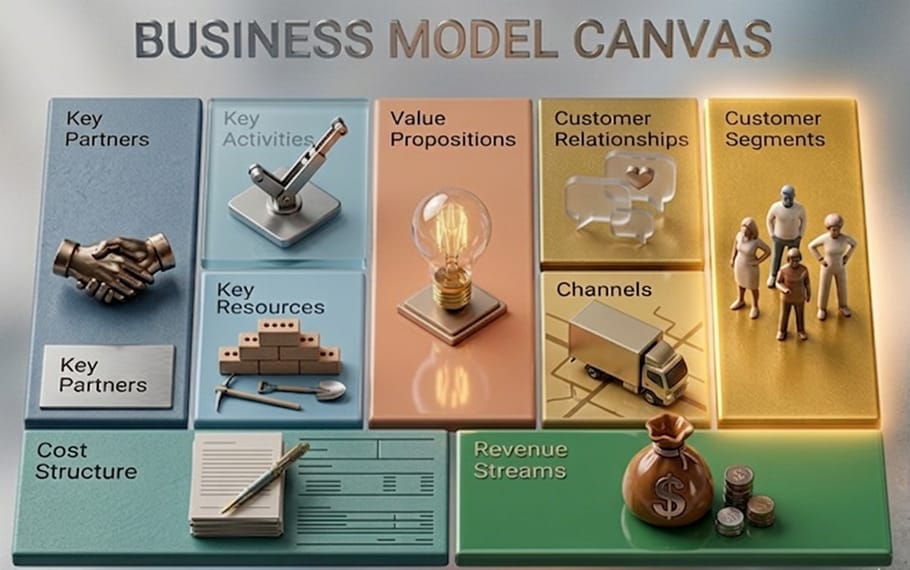
In the Business Model Canvas, the 'Value Proposition' sits at the center, but the 'Customer Segments' block is the foundation. That isn't a coincidence. Change your segment, and you aren't just adjusting a slide deck. You are redrawing your entire business model. Your channels, revenue streams, and cost structures must pivot, or they will break.
Why B2B Is Different
In B2C, one person decides. In B2B, you're selling to a Buying Committee. The Operations lead wants efficiency. IT wants security. Finance wants predictability.
When an organization doesn't segment, it writes one message for five people and lands with none of them. Worse, the Product Roadmap becomes a mess of compromising features trying to please everyone while satisfying no one.
Here's where this gets expensive. If your roadmap is shaped by unfiltered feature requests from multiple, mismatched customer types, you're not building for excellence. You're building for mediocrity. Industry-specific messaging increases response rates by 31%, yet most B2B companies are still broadcasting generic value props that resonate with nobody in particular.
And this isn't just a marketing problem. When your product team doesn't know who the product is really for, they build for everyone, which means they build for no one. You end up with:
- Features that conflict with each other
- Pricing that doesn't align with any segment's willingness to pay
- Onboarding flows that confuse half your customers
- Support teams drowning in questions that should have been solved by design
Segmentation is product strategy. It tells you what not to build just as much as what to build.
The Math of Growth
Segmentation shows up in your CAC (Customer Acquisition Cost). A mid-market firm might close in 60 days, while an enterprise will take nine months. If you apply the same sales effort to both, your margins will vanish. Segmentation-based personalization increases B2B ROI by 142%, and intent-based personalization accelerates sales cycles by 30%.
Retention tells an even sharper story. Research from Totango shows 64% of enterprise churns are preventable, driven by weak relationship management. But here's what most teams miss: that statistic only applies to enterprise customers. For smaller businesses, churn usually means they've outgrown you. They need more scale, more features, or they've been acquired.
Same symptoms. Completely different cure.
If you treat enterprise churn and SMB churn as the same problem, you'll waste the most precious resource you have time. You'll build retention programs for customers who were always going to leave and miss the enterprise accounts that were quietly deciding you didn't understand them.
And the cost of getting this wrong? Poor customer experience costs B2B companies 20% of annual revenue on average. That's not a rounding error. That's a crisis hiding in plain sight.
The Practical Move
You don't need five segments to win. You need one, understand deeply.
Here's why focus wins. Your Ideal Customer Profile isn't just a targeting decision. It's a positioning decision. When you become known as the solution for a specific type of customer, referrals compound. Trust transfers. Word of mouth becomes your competitive moat. Deals close faster because buyers recognize exactly what you stand for and who you serve best.
Pick the group that feels the pain most acutely and values what you are genuinely best at delivering. Not the biggest segment. Not the easiest to reach. The one where you can become indispensable.
Master that ICP first. Let the data and the proof points build around it. Let your early customers become your case studies, your advocates, your co-marketers. Then, and only then, expand.
In B2B, the fastest path to scale isn't casting a wider net. It's becoming the obvious choice for the right people first.