


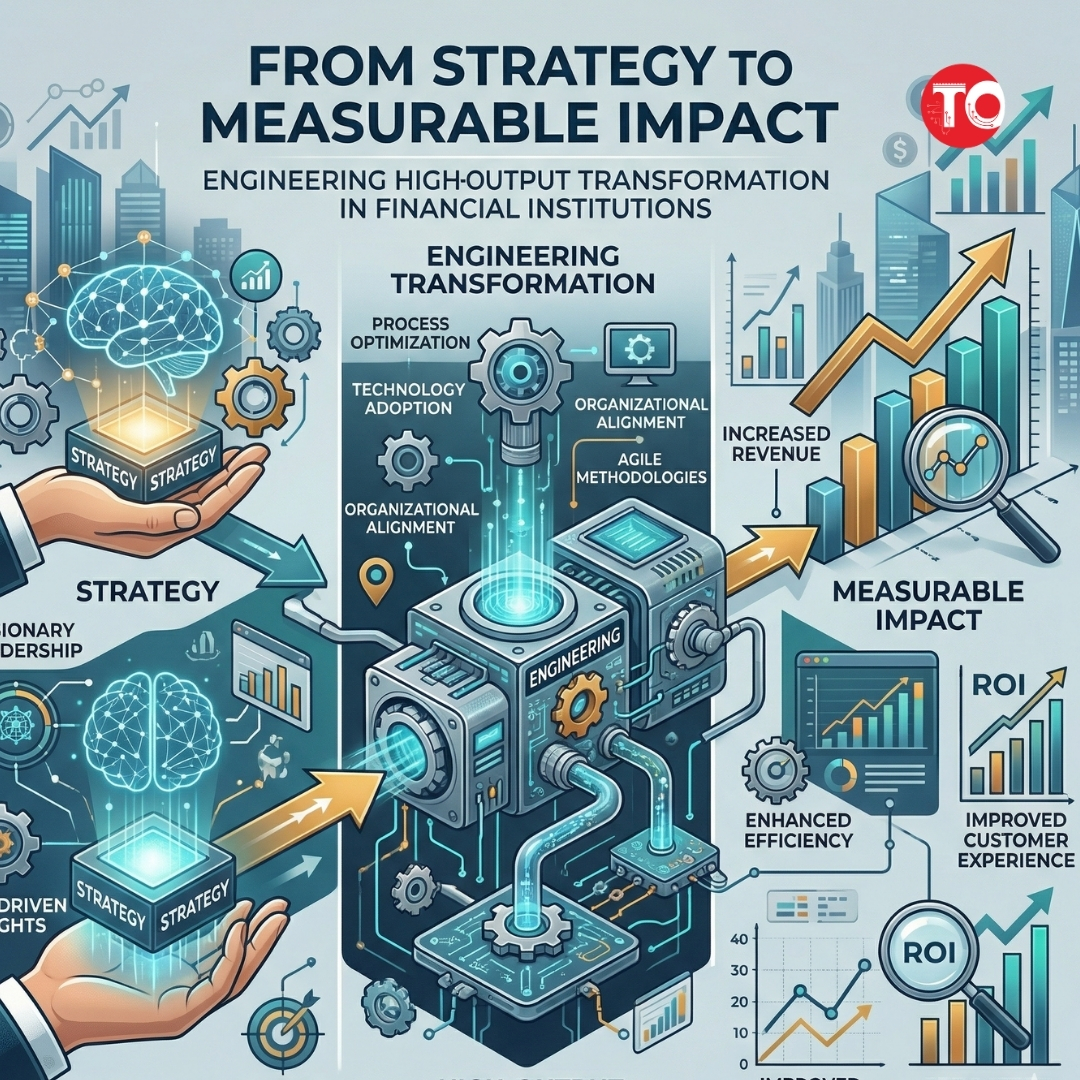
Across the global financial sector, transformation is no longer driven solely by technology adoption. Increasingly, its success depends on how effectively institutions convert strategic ambition into measurable outcomes.
Artificial Intelligence is strengthening credit analytics, liquidity forecasting, fraud detection, and operational efficiency across banks and financial services organizations. Yet technology alone does not guarantee meaningful transformation. Sustainable progress requires disciplined execution — where strategy, processes, people, and intelligent systems operate within a structured and measurable framework.
Leading financial institutions now approach transformation as an integrated management system rather than a series of isolated initiatives. Strategic roadmaps provide direction and clarity of priorities. Performance frameworks monitor both financial and operational indicators. Objective-based management models align departments and teams with enterprise-wide goals, while portfolio governance ensures resources are allocated where they create the most value.
When these elements operate together, the benefits become visible across the organization. Institutions adopting structured strategy-tracking disciplines often achieve stronger cross-functional coordination, more efficient resource utilization, earlier identification of underperforming initiatives, and greater transparency around return on investment. Transformation moves beyond activity-based reporting and becomes focused on measurable impact.
This approach enables what can be described as 360-degree value realization. Instead of measuring transformation purely by project delivery, financial institutions evaluate outcomes across asset quality, operational productivity, liquidity management, cost efficiency, workforce alignment, and customer experience. Leadership gains clearer visibility into how strategic initiatives strengthen institutional resilience and financial performance.
The underlying principle is simple but powerful. Strategy must translate into operational processes, and those processes must be supported by people and intelligent analytics. When these components function in isolation, transformation becomes fragmented. When integrated effectively, institutions create an environment where strategy execution becomes consistent, transparent, and scalable.
For Oman’s financial sector, this evolution represents a natural next step in institutional maturity. Strong regulatory governance already supports stability and accountability across the industry. As digital and AI-driven capabilities continue to expand, the opportunity lies in ensuring that transformation initiatives are executed with the same discipline applied to capital adequacy, liquidity management, and risk oversight.
Artificial Intelligence can significantly enhance institutional capability. However, it is structured execution that converts that capability into measurable value.
In today’s financial environment, successful institutions are not defined only by the technologies they adopt, but by how effectively they translate strategic vision into sustained performance.