




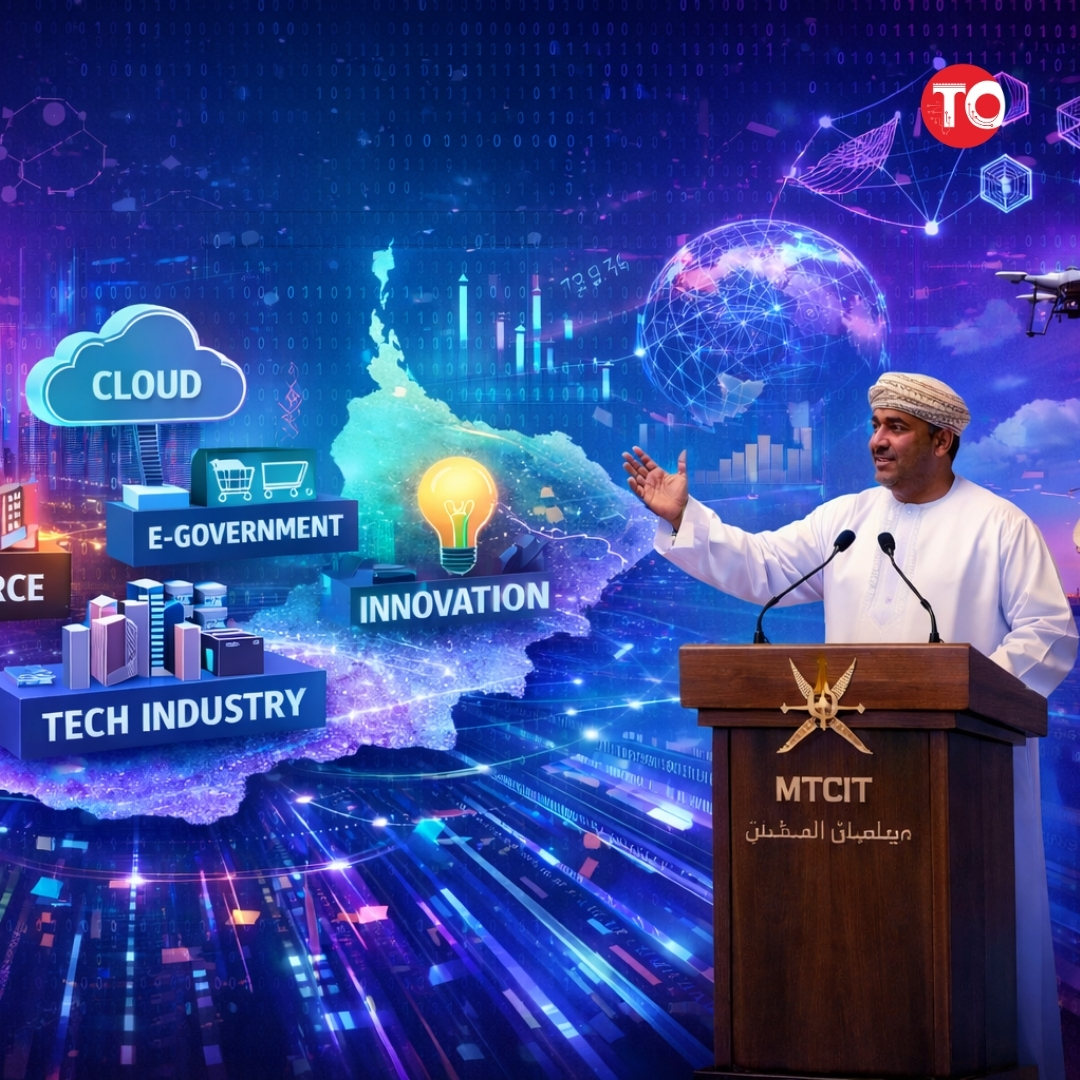
The Ministry of Transport, Communications and Information Technology (MTCIT) has announced a new package of initiatives aimed at strengthening Oman’s digital economy over the coming five years. The plan includes establishing digital transformation centres in all governorates and enhancing national capabilities in areas such as artificial intelligence, cybersecurity and cloud infrastructure.
Scheduled to run from 2026 to 2030, the programme forms part of the government’s wider efforts to accelerate digital transformation and encourage technological innovation across key sectors of the economy.
A key proposal involves setting up digital transformation centres in every governorate. These centres will be designed according to the economic and technological characteristics of each region, helping drive local development and broaden the adoption of digital technologies in production and services.
Authorities are also planning to develop a national predictive intelligence platform based on large language models to support government decision-making through advanced data analysis.
The initiative further includes measures to strengthen national cybersecurity companies and encourage local manufacturing and assembly of servers and cloud infrastructure equipment, reducing dependence on foreign suppliers.
In addition, plans are being studied to create an integrated cloud environment capable of processing satellite data for economic and research applications. Officials are also exploring the possibility of launching a national payment card to enhance financial independence in the digital payments sector.
MTCIT highlighted these developments in a report titled Harvesting the Digital Economy in the Sultanate of Oman: From Establishment to Empowerment, which reviews the sector’s progress between 2021 and 2025.
The report states that the digital economy contributed around RO800mn to Oman’s national economy in 2023, underlining its growing importance in the country’s economic diversification efforts.
According to H E Saeed bin Hamood Al Mawali, Minister of Transport, Communications and Information Technology, the next stage will focus on digitising promising sectors of the economy and expanding exports of digital services, with the goal of increasing the digital economy’s contribution to GDP to about 10% by 2040.
H E Dr Ali bin Amer Al Shidhani, Undersecretary for Communications and Information Technology, said the National Programme for the Digital Economy (2021–2025) has achieved notable progress. This includes the launch of a unified digital government services portal and the national Tajawob platform for proposals and reports.
Over the past five years, more than 2,200 government services and permits have been digitised, while annual digital government transactions have exceeded 29mn.
The report also highlighted that investments in artificial intelligence have surpassed RO79mn. In addition, more than 11,000 Omanis have received digital skills training through the Makin initiative, which aims to support the technology labour market.
Key Facts
- Digital transformation centres planned in all governorates
- AI-based platform to assist government decision-making
- Digital economy contribution targeted at 10% of GDP by 2040
- Over RO79mn invested in artificial intelligence
- More than 2,200 services digitised in the past five years